
The Dark Phoenix Saga is a story that revolves a central theme: “absolute power corrupts absolutely”. While the corrupting nature of power is the core focus of the story, the other concept being emphasized is empathy. Dark Phoenix herself is the X-Man known as Jean Grey, a telepath and telekinetic who sacrifices herself and bonds with a cosmic entity known as the Phoenix Force to save the lives of her friends.
She eventually rises from her presumed death and takes on the name Phoenix, rejoining the X-Men. By bonding with the Phoenix Force, Jean has gained untold power on the levels of godly heroes like Thor, except that her power seems to keep growing. The first stories that take place as we witness Phoenix showing off her new power are generally referred to as the Phoenix Saga. The Dark Phoenix Saga, on the other hand, is all about Jean Grey becoming increasingly powerful and more addicted to said power, culminating in her transformation into the crazed and destructive Dark Phoenix.
The saga introduces us to characters that would stand the test of time such as the radiant Dazzler, the phasing Kitty Pryde, the telepathic mean-girl Emma Frost, and the villainous Hellfire Club. The X-Men go to recruit Dazzler and Kitty, unaware that the Hellfire Club has similar plans. The illusionist Mastermind ranks among their numbers, and he is committed to converting Jean Grey to their side via romantic, entrancing illusions of him and herself in colonial times. Jean thinks they are visions of a past ancestor, some side effect of the X-Men’s cosmic adventures or her new powers, but we know the truth.
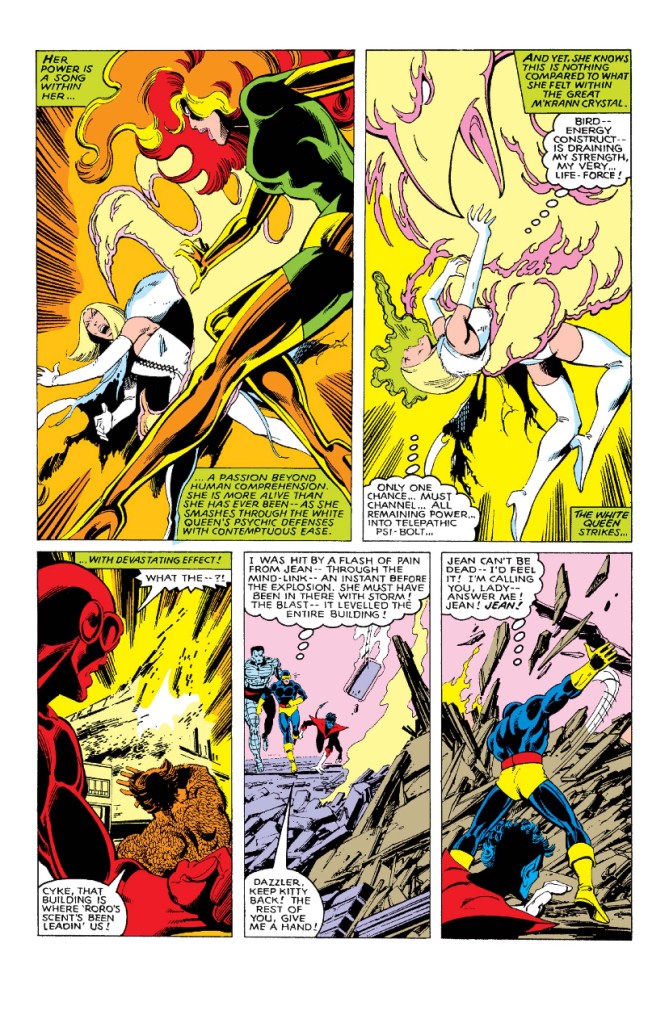
Alongside her growth in power, Jean’s personality shifts as well. She becomes more reckless and notices herself enjoying violence. In her battle with rival telepath Emma Frost, it’s made clear that Jean is only toying with her enemy before easily overwhelming her. Her power is described as “a song within her…a passion beyond human comprehension.” There’s a newfound exhilaration in using her power that wasn’t there before.
After their first battle with the Hellfire Club, the X-Men proceed to infiltrate one of its elitist parties. Here, Mastermind makes good on his plan to convert Jean, whisking her away from Cyclops before he realizes what’s happening. By the time Cyclops realizes that this supposed gentleman is actually their past foe, Jean has already been made the Hellfire Club’s “Black Queen”: a scantily clad dominatrix who feels no pity or remorse.
Most of the X-Men lose their respective fights and are captured, leaving only Kitty Pryde and Wolverine to free their friends. There’s an uncomfortable scene of Jean seeing the X-Men through a colonial illusion as disobedient servants, where Storm is referred to as a slave and slapped. Granted, one could argue that this represents the violent reality of colonial times that had only been seen through a romantic lens by Jean up to this point, but it’s still a jarring scene.
While Cyclops, Storm, Colossus, and Nightcrawler are held hostage, Cyclops is able to reach out to Jean through their mental rapport and snap her out of Mastermind’s control. With Wolverine and Kitty’s help, Jean breaks the other X-Men free and they proceed to finally defeat the Hellfire Club. The iconic scene from this fight is Jean punishing Mastermind for his constant attempts to control her.
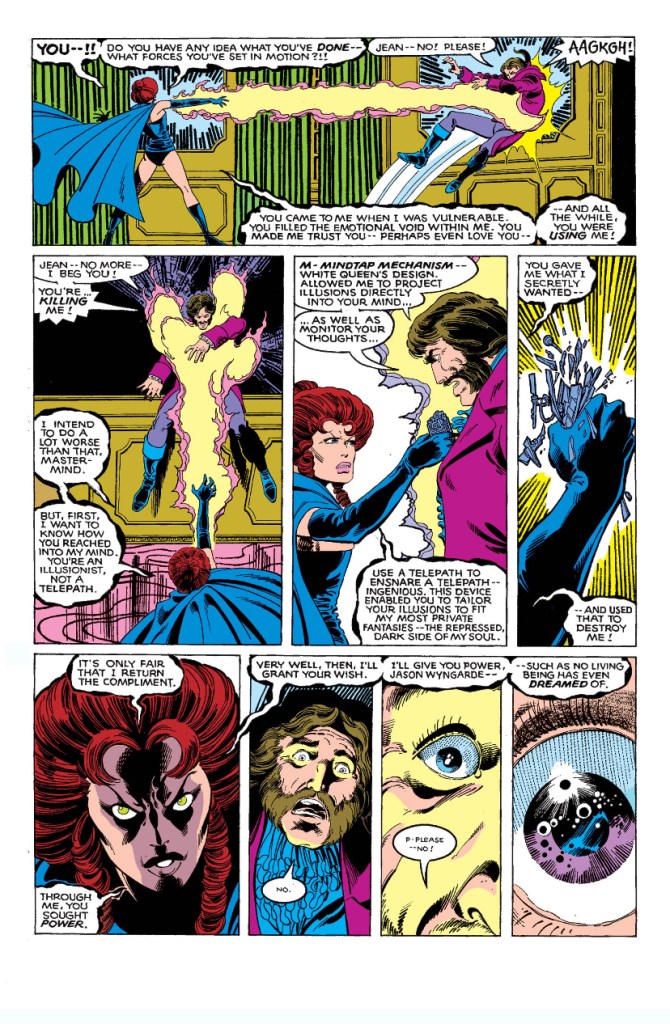
She corners him with an air of eerie menace, cloaked in shadows. She taunts him about his lust for power and control, offering him more power than he can handle. Jean floods Mastermind’s mind with “all the myriad, absolute, contradictory truths of existence”. The villain is left drooling and comatose, again emphasizing just how much power Jean has access to as Phoenix.
As the X-Men escape on their jet, Cyclops notices how Jean won’t talk to him and has cut off their psychic connection. He secretly resolves to rush Jean to Professor Xavier so he can help her resist the Phoenix force, but it’s too late. Jean explodes in a display fiery power, destroying the jet and transforming into Dark Phoenix.
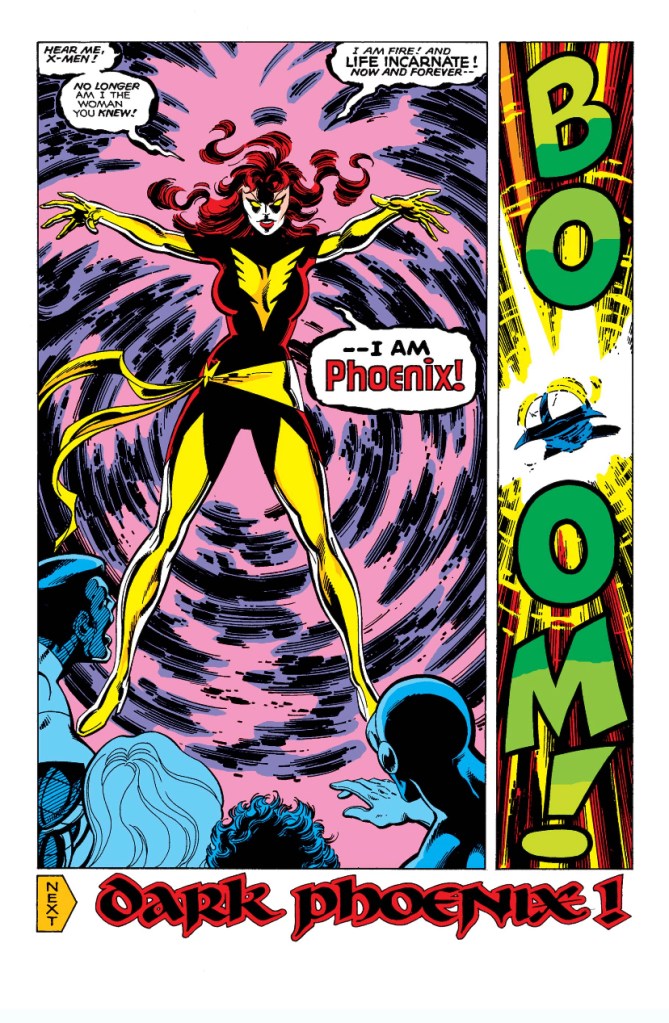
What follows is a very one-sided battle: Dark Phoenix wipes the floor with the X-Men. Every attack made against her is rendered ineffective and countered. She turns a tree Colossus is holding into solid gold, absorbs and redirects Storm’s lightning bolts, and overwhelms Nightcrawler and Cyclops with sheer psychic force. Jean launches into space as a giant, fiery phoenix, grabbing the attention of various heroes throughout New York City. The Fantastic Four, Doctor Strange, Spider-Man, and even the Silver Surfer witness and sense the massive display of power.
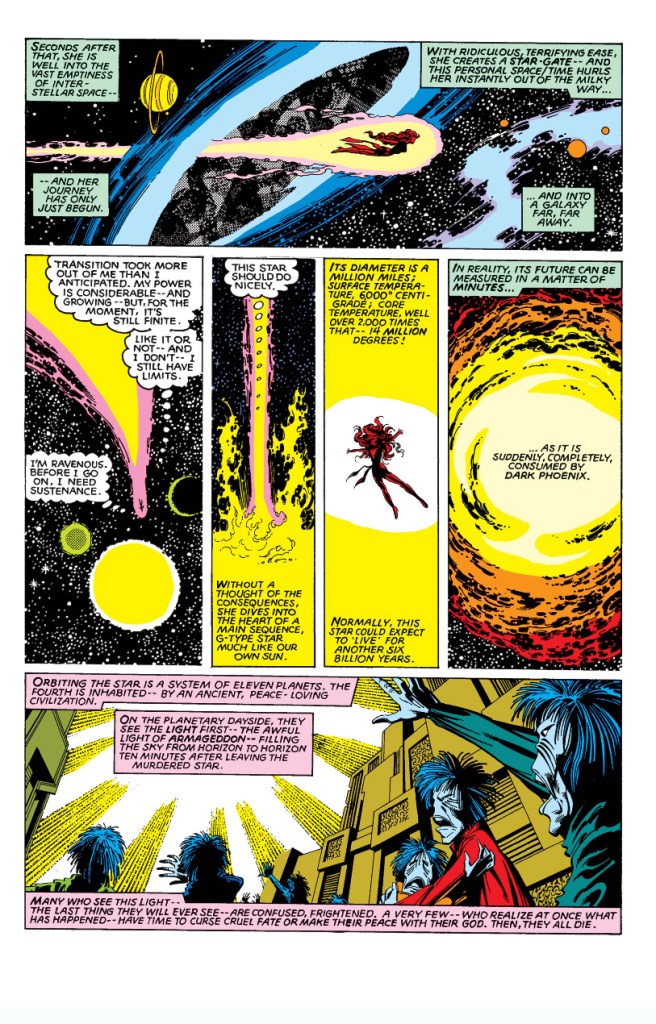
Jean proceeds to soar through space, opening a “star-gate” to travel between galaxies in an instant. Ravenous, free, and unchecked, she dives into a nearby sun in order to feed on its energy. In doing so, she causes a destructive super-nova that obliterates an inhabited planet. This marks Jean Grey’s moral event horizon: the act she can’t morally come back from. One can say that Dark Phoenix is more Phoenix than Jean, but the reality is that she is still some part of Jean’s own dark desires and passions. Up until now, Jean’s destructive powers haven’t had much real consequence for anyone except Mastermind and her relationship with her friends, but now the blood of billions is on her hands.
Equally as important, Dark Phoenix barely processes what she’s done. She just doesn’t care about the consequences of her actions. The narration supports this, declaring, “What matters is that Dark Phoenix lives! And all creation is her domain-to do with as she pleases.” Dark Phoenix holds god-like power and uses it without consideration for anyone but herself. She’s the personification of hedonism, pursuing only what brings her joy and power, no matter the cost.
Again, empathy and power are the major themes here. Dark Phoenix embodies power and wastes no time on empathy. Jean Grey, however, is empathetic to a fault. She’s a loyal friend and lover (although the latter has been tested by Wolverine) and an adamant defender of the innocent. Within Jean Grey are dueling desires: become a selfish god, or remain a selfless woman?
Dark Phoenix returns to Earth, walking the quiet rooms of Jean’s childhood home. This is an introspective moment that juxtaposes her recent rampage through the stars. Jean is trying to reconnect with her human side, resisting the urge to abandon it. The moment doesn’t last as she’s interrupted by her parents and sister who show concern for her in her strange new costume. Jean’s unable to keep their thoughts out of her head, and Dark Phoenix emerges again as she enrages at their fear of her.
Just as tensions begin to rise, the X-Men arrive and ambush Dark Phoenix before she can bring harm to her family. The team tries to neutralize her vast mental power with an inhibiting headband device that Beast created, though it only works temporarily. In that time, the team has an opportunity to kill Jean.
Wolverine tackles Jean and prepares himself to do what no one else is willing to do, but Jean’s personality overpowers Dark Phoenix. She tearily pleads that Wolverine kill her while he has the chance, but he hesitates for too long. Dark Phoenix resurfaces, blasting him away and trapping all the X-Men in a telekinetic stasis.
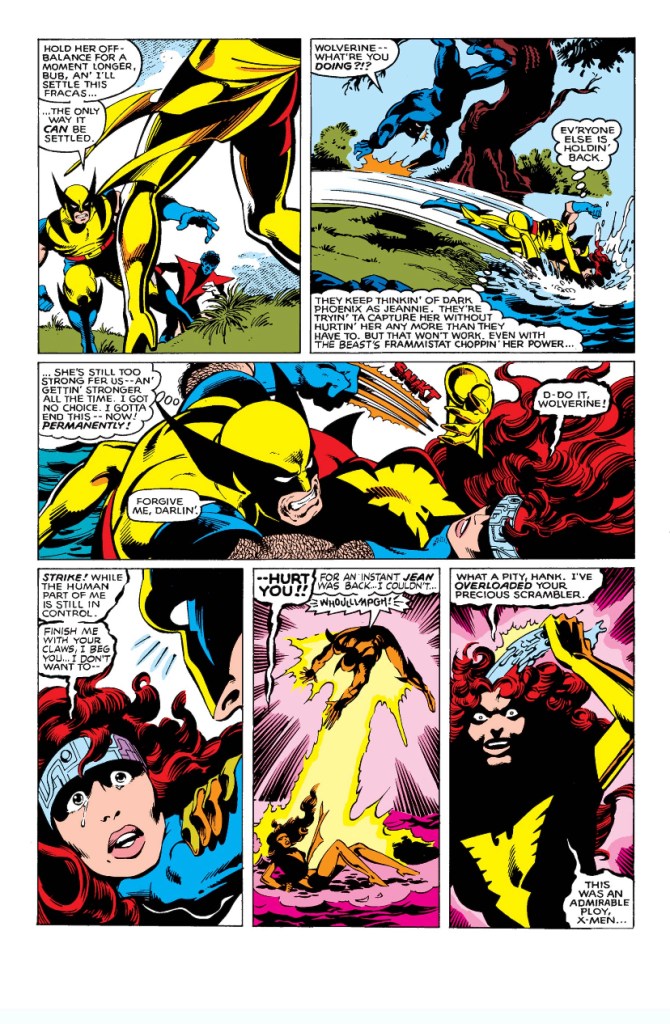
I’d stress to you how Wolverine and all of the X-Men care about their friend too much to bring themselves to hurt her, but Cyclops does it for me: “True, you’re Dark Phoenix, but you’re also still Jean Grey…You can’t kill us because you love us. And we love you.” Jean came back to Earth because she wasn’t ready to part ways with her human side, and she can’t significantly harm the X-Men because she still cares, despite what she tells herself.
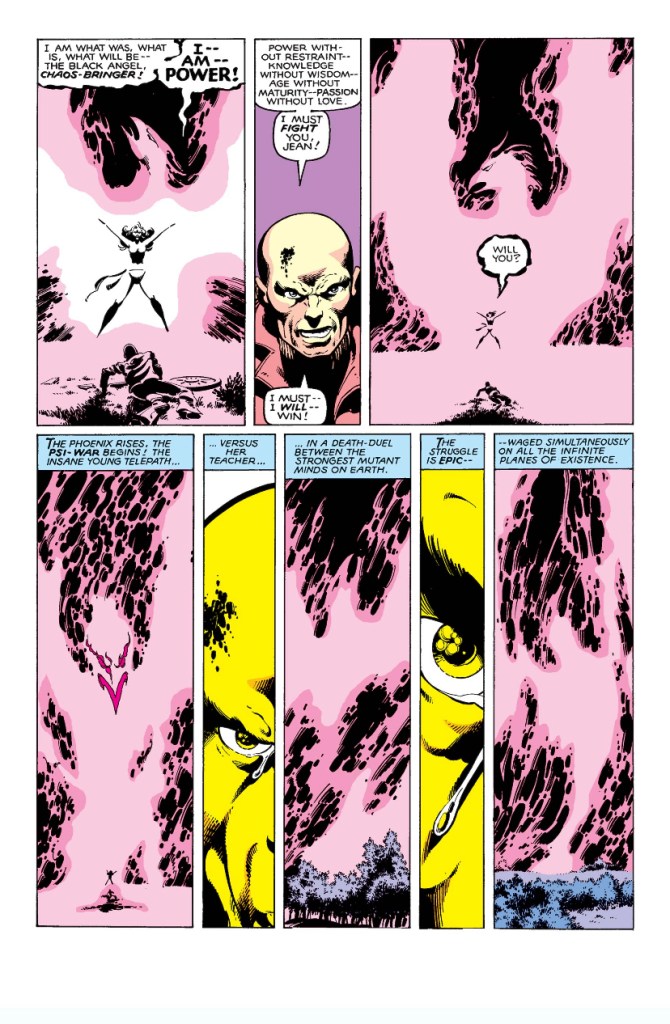
As Cyclops is breaking through to Jean, Professor X attacks her with a psychic blast. She enrages yet again as she and her mentor prepare themselves for a psychic duel. The cataclysmic art of their battle helps guide the reader’s imagination, as their surroundings ignite with psychic energy in their struggle over Jean’s very soul. While psychic fights in X-Men tend to take place in the astral plane, a realm of pure thought, the battle between Dark Phoenix and Professor X leaves you in the physical midst of their titanic struggle.
You feel Professor X’s intensity and desperation as a tear runs down his face, and he just barely succeeds in locking the Phoenix away in Jean’s mind, allowing her to revert to her original self. Unable to get a moment’s rest, however, the X-Men are beamed into space before the Shi’ar Council, who demand that Jean pay for her crimes as Dark Phoenix with her life.
Professor X, having spent time in space with the Shi’ar Empress, Lilandra, invokes a trial by combat: the X-Men vs. the Shi’ar Imperial Guard, a team of elite super warriors. Lilandra has no choice but to accept, giving the X-Men a single night to rest before battle. Each member of the team reflects on their decision to protect Jean and wonders if it’s the right decision.
Though they come to the same conclusion in fighting for Jean, their varied reasoning is interesting. Jean herself reflects on the godlike power she wielded just hours ago, deciding that she should pay for her crimes. Wolverine is confident that Jean and Phoenix are two separate entities. Beast stands firmly behind the rule of law and decides that even if Jean was evil, she’d deserve a fair trial instead of an execution. Colossus decides he cannot abandon a beloved friend, no matter what. Nightcrawler, Angel, and Storm are conflicted on if they’re morally in the right, but they decide to defend Jean anyway.
Cyclops is last, as we see his thoughts when he confronts Jean the next morning. He fears that Dark Phoenix might resurface, understanding where those who want Jean’s death are coming from. Still, he resolves that he doesn’t think vengeance is for them decide and that Jean has done too much good in her life to die like that. He and Jean embrace as he concludes that he must fight for her life. It was never really in doubt whether Cyclops would fight for the love of his life, or if any of the X-Men would fight for their friend, but it feels very genuine that they’d fight for her even when they aren’t sure it’s the right thing to do.
Jean wears her original Marvel Girl outfit, committed to dying as Jean Grey and not as Phoenix. The team ends up facing the Imperial Guard in fierce battles on the Moon, but ultimately, they are each defeated by their various super-powered opponents. Cyclops and Jean are left to fare for themselves, running hand-in-hand as they hold off their pursuers. They pledge their undying love to each other yet again as they charge into their final stand, facing the wrath of the entire Imperial Guard.
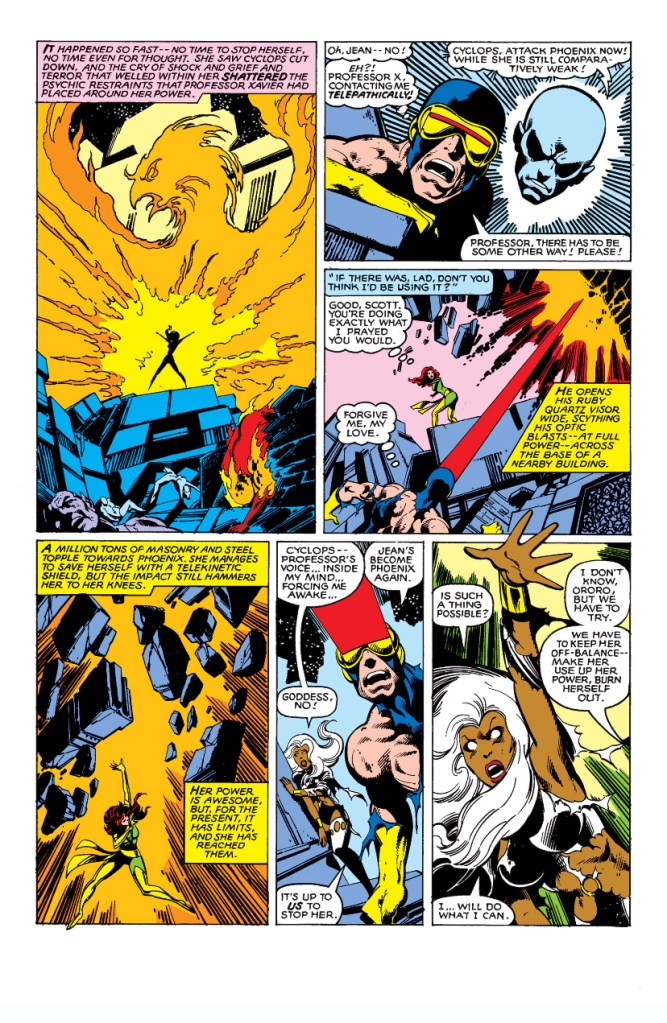
In the midst of this last stand, Jean surprises everyone by bursting with Phoenix energy and appearing in her Phoenix costume again. Everyone is shocked and put on high alert, with the X-Men rousing from their defeated states. They resolve to stop her before she grows stronger, culminating in a last ditch effort by Colossus to strike a killing blow. True to form, though, the gentle giant pulls his punch at the last instant, unable to kill his friend.
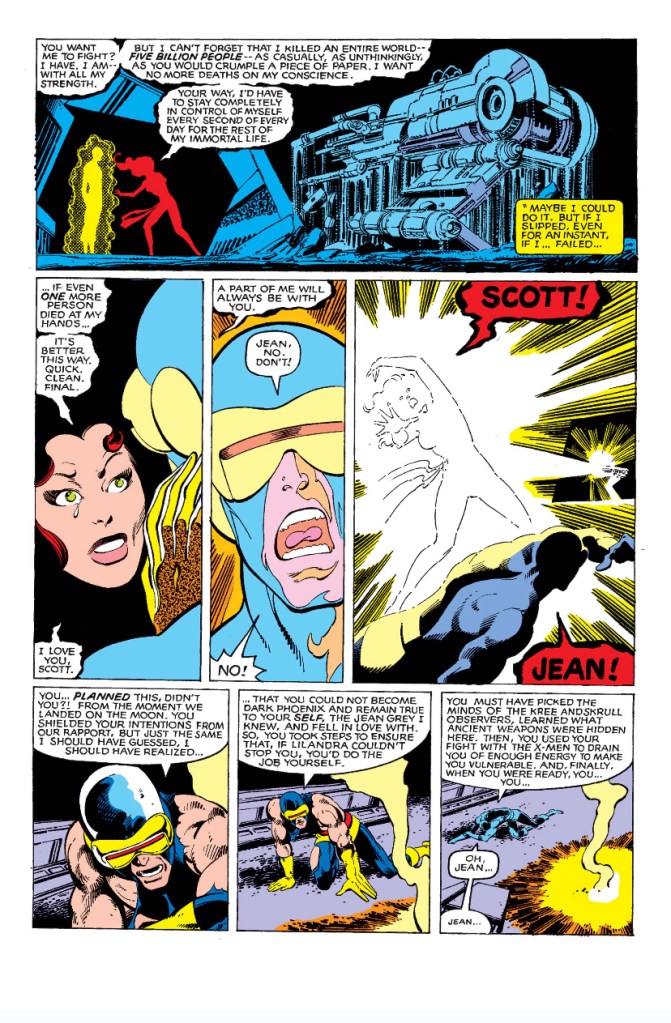
Jean is surprised that Colossus couldn’t do it and comes to a realization: she will always turn back into Dark Phoenix, no matter what they do to stop it. She begs the team to kill her before it’s too late. When it’s clear that they won’t do it, she escapes into a small corridor as Cyclops chases her. Jean places him into a telekinetic stasis as he enters the room, tearfully admitting that she feels the weight of the billions of lives she’s responsible for ending. She says that she won’t be able to resist the Phoenix Force for long and that anymore deaths on her hands would be too many. After a final statement of love for Cyclops, she activates a hidden weapon and dies at her own hand.
In the end, Cyclops laments that Jean must have planned this ever since they were beamed into space. Marvel’s enigmatic observer known as The Watcher narrates, “Jean Grey could have lived to become a god. But it was more important to her that she die…a human.”
The themes of the Dark Phoenix Saga aren’t very complicated. They’re mostly spelled out for you on the page, courtesy of writer Chris Claremont’s evocative descriptions and moral pondering. The reason the saga is so iconic is because it’s a truly classic story: the temptation and seduction of power, the thrill of using it, and the struggle to turn against it. The Dark Phoenix Saga is a timeless, fable-like warning of the destructive nature of power, its effect on your relationships, and its effect on your own identity.
(Uncanny X-Men (1963) #135 Cover by Writer: Chris Claremont, Penciler: John Bryne, Inker: Terry Austin, Letterer: Tom Orzechowski, Colorist: Bob Sharen)

 MasqMusings